


Who was St. David of Wales?
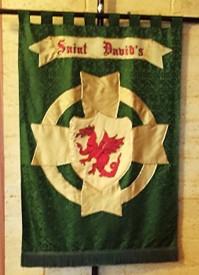
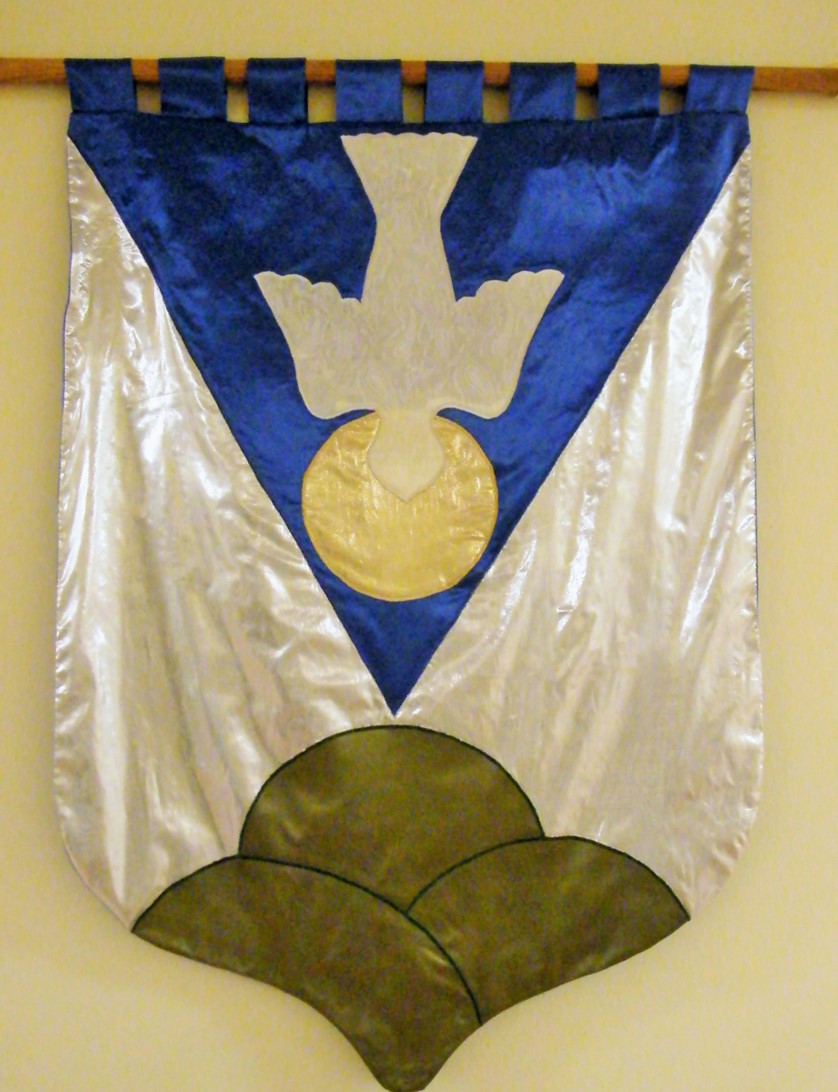 Saint David, or Dewi Sant in Welsh, is the patron saint of Wales. He was a Celtic monk, abbot, and bishop in the sixth century. He served as the archbishop of Wales, and was one of the early saints who spread Christianity among the pagan Celtic tribes of western Britain. St. David’s Day is celebrated on March 1st.
The red dragon on the banner in our church sanctuary is a symbol of Wales. Our other banner about St. David bears a dove descending over three green hills. It relates to a legend that when St. David was asked to speak to the multitude at the Synod of Brefi in Wales, the Holy Spirit settled on him in the form of a dove, and the ground miraculously rose to form a mound, raising him so all could see and hear.
From “Every Earthly Blessing” by Esther deWaal:
"Celtic Saints are approachable, close at hand, woven quite naturally into life just as would be any other member of an extended family. The Celtic sense of the communion of saints comes across very strongly in a poem by Gwenallt in which he says that the barriers go down between this world and the next, and St. David comes among us in Wales today, traveling around the country like a gypsy, going into schools and colleges, mines and factories, and finally coming into our own homes."
= = = = = = = = = = = = = = = = = = = = = = =
The story of Saint David begins with his auspicious birth in the early sixth century. He was born to Saint Non, the daughter of a local chieftain, in the midst of a strong thunderstorm, on the rocky cliffs above the bay on the Southwest coast of Wales. While rain, lightning, and thunder filled the air, the sacred place of Dewi’s (as he’s known in Welsh) birth was filled with light and serenity.
Dewi was of royal lineage as his father, Sant, was the son of Ceredig, the prince of Ceredigion, a region of Southwest Wales. As was the custom of the Celtic peoples, children from prominent families in a region were often raised by foster families in neighbor-ing regions. This custom formed networks and created interdepend-dent social ties that strengthen the community and gave the child the advantage of having a large extended family. In that custom, young Dewi was sent to the family of a bishop to be fostered.
From an early age, David was dedicated to the church and he was educated in a monastery called Hen Fynyw by Paulinus, a blind monk. He studied in tutorial fashion as he learned Scripture, history, and tradition. His education prepared him for a life of Christian service.
He set out on missionary travels and to found twelve monasteries, establishing his last monastic settlement at Glyn Rhosyn (Rose Vale) on the banks of the river Alun, the current day cathedral city of Saint David’s in southwest Wales on the Pembrokeshire coast. In time, David became both abbot and bishop; his leadership was recognized and welcomed. He is also said to have been a worker of miracles – his first miracle was to restore the sight of his teacher Paulinus.
David is said to have been around six feet tall and very strong. He never shirked physical labor and though he lived mainly on water, vegetables, and herbs, he was capable of pulling a plough like an ox. He chose to live a simple life, dedicated to Christ, and included in his rule prayers, hard work, and crafts--including beekeeping. Despite his personal austerity, David was noted for treating others with respect and kindness, particularly pilgrims, travelers, and the poor and needy of the neighborhood.
His words and his way of life encouraged many to join his community. In the monasteries David founded, all was owned in common; the word “my” was not used. It is his emphasis on community, rather than his asceticism, that continues to influence Christianity in Wales. By all accounts, David was a man of true kindness, dedicated to a life of service in the name of his Lord. Humane interaction characterized his dealings with all people – old and young, rich and poor, stranger and friend.
As David lay dying, he reminded the people gathered that they were to follow his example, to care for one another in “the little things.” His last words to his community and friends were in a sermon on the Sunday before he died: “Be joyful, and keep your faith and your creed. Do the little things that you have seen me do and heard about.” This phrase “Gwnewch y pethau bychain” (do the little things) is a very well-known phrase today in Welsh, and is an inspiration to many.
David was canonized by Pope Callactus II in 1120 and his feast day set for March 1st. We celebrate St. David’s day with the remembrance of his call to serve the least of these and do the “little things” and with some of the symbols of his life: daffodils and leeks.
= = = = = = = = = = = = = = = = = = = = = = =